What does 35pt mean on a toploader?
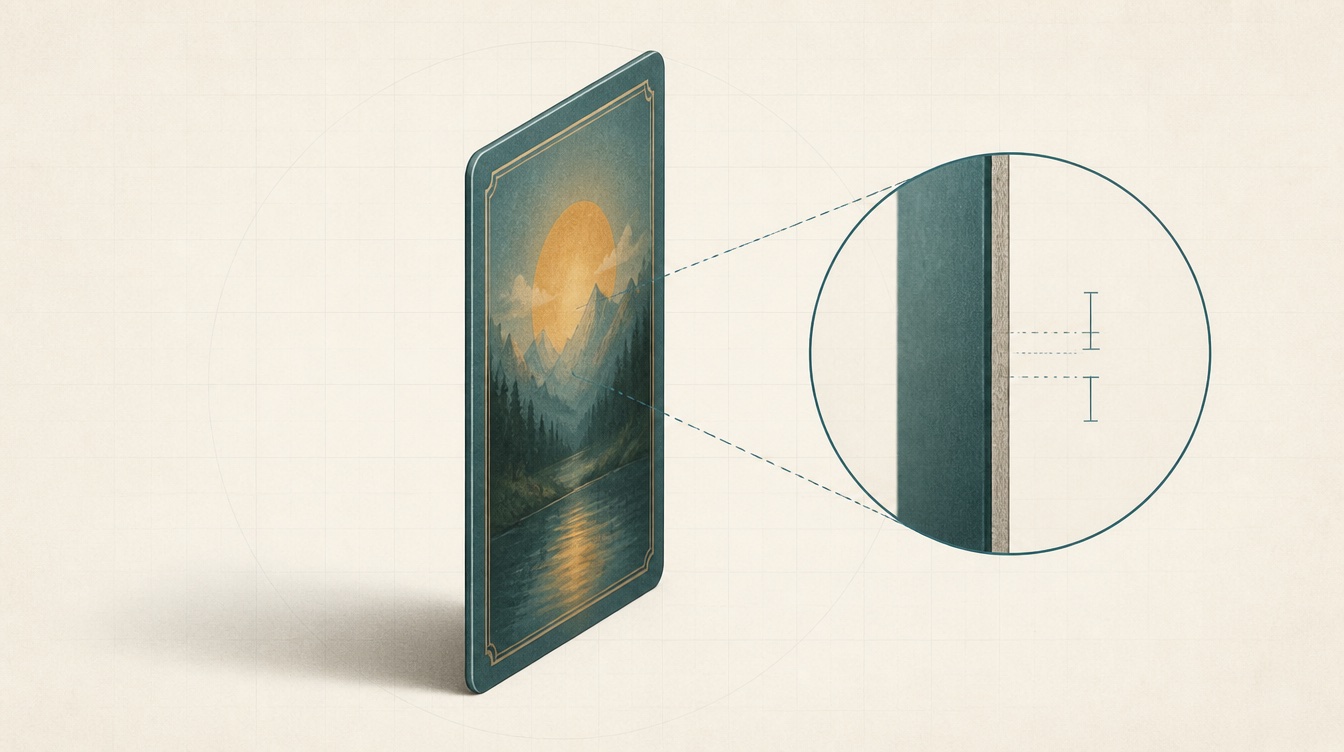
Pt stands for points, and one point equals one thousandth of an inch, or 0.0254mm. A 35pt toploader is rated to hold about 0.89mm of card thickness. It has nothing to do with the card's width or height; every 3x4 toploader in our data measures the same footprint on that front. The pt number is purely about how much depth the holder gives a card (or a sleeved card) to slide through and sit in.
Points to millimeters
Since a point is a fixed fraction of an inch, converting any pt rating to millimeters is simple multiplication: pt x 0.0254. Here's the full range that shows up across the toploaders in our data.
| pt rating | mm (pt x 0.0254) |
|---|---|
| 35pt | 0.89mm |
| 55pt | 1.40mm |
| 59pt | 1.50mm |
| 75pt | 1.91mm |
| 79pt | 2.01mm |
| 100pt | 2.54mm |
| 108pt | 2.74mm |
| 130pt | 3.30mm |
| 138pt | 3.51mm |
| 180pt | 4.57mm |
Notice the two brands don't always line up on round numbers. Ultra Pro's tiers land on 35, 55, 75, 100, 130, and 180, while BCW's land a little higher at each step (59, 79, 108, 138). They're covering the same rough job, thin card versus thick card, just with slightly different marketing round numbers.
Why 35pt is the standard
A standard trading card (Magic, Pokemon, One Piece, Lorcana, Flesh and Blood) is 0.305mm thick, which works out to about 12pt using the same conversion. A 35pt toploader gives that card roughly three times its own thickness in clearance. That's not excess. It accounts for a penny sleeve around the card, plus the slack needed to actually slide the card in and pull it back out without scraping the corners or forcing the plastic. Go much thinner than 35pt and a normal card would be a tight, awkward fit. Go much thicker and you're carrying capacity you don't need for a single standard card.
When the number stops being about a single card
Once you're past 100pt, the extra millimeters aren't really about one card getting thicker anymore, since almost no single trading card approaches even a millimeter on its own. At that point the pt rating is doing one of two jobs: holding a card with real, unusual thickness (a multi-layer patch or relic card, for instance), or holding a small stack of several cards sleeved together. Reading the pt number as "how thick a single card is" starts to break down at the high end; it's really "how much total material fits through this opening."
Quick answers
Is 35pt the same as a raw card's thickness? No. A raw standard card measures about 12pt on its own. The 35pt rating is the toploader's capacity, built with extra room for a sleeve and handling slack, not a measurement of the card itself.
What does the pt number tell you about width and height? Nothing. Every 3x4 toploader we have interior data for opens to the same rough footprint (around 69.9x98.4mm) regardless of pt. The number is entirely about thickness capacity.
Is a higher pt number always better protection? Not for a normal card. A 180pt toploader around a 12pt raw card leaves a lot of empty space for the card to shift and rattle. Match the pt to the actual thickness of what you're storing; see our toploader size chart for guidance by card type.
How do I know if I need more than 35pt? If a sleeved card won't sit flat, bows the toploader slightly, or you can feel resistance sliding it in, that's your sign. We break down exactly where that line sits in 35pt vs 55pt toploaders.
Once you know pt is a thickness unit borrowed straight from the printing and paper world, the whole toploader aisle stops being a mystery. It's not a size tier system. It's a depth gauge, and 35 is the depth a normal card needs.