What size bubble mailer for trading cards?
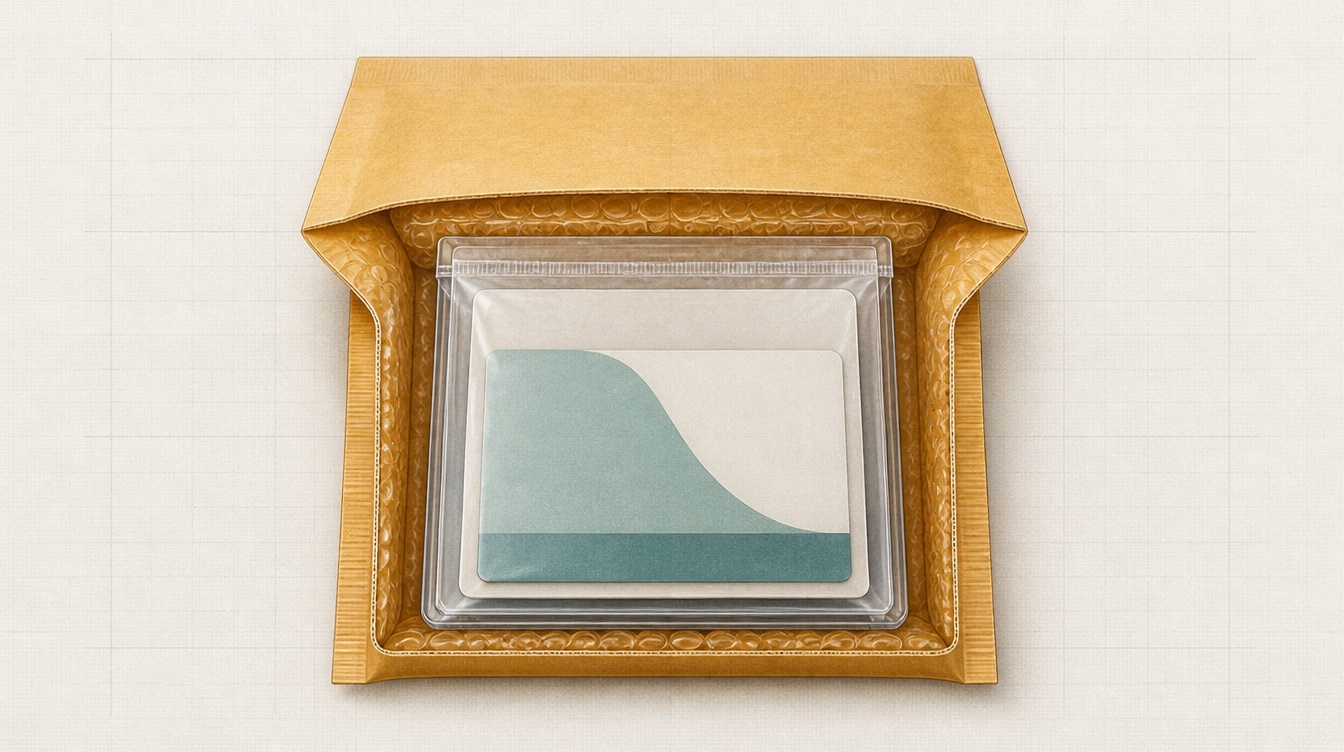
A 4x8in bubble mailer is the size most sellers reach for to ship a single sleeved card in a 35pt toploader: enough room to slide the toploader in flat with a little padding around it, without leaving so much extra space that it slides around and takes corner hits during transit. Stacks of a few cards, thicker toploaders, or anything already in a rigid slab need a bigger mailer, and the jump usually lands at 6x9in.
Why size matters more than it seems
The instinct is to grab whatever mailer is on hand, but a mailer that's too big is its own problem. A toploader with room to travel inside an oversized mailer will find the corners of that mailer during a bumpy truck ride, and a toploader corner meeting a mailer edge repeatedly is exactly how a card ends up with a bent tip despite being packed. Too small is the opposite failure: you either can't fit rigid backing alongside the toploader, or you're folding the mailer to force it shut, which puts pressure right where you don't want it.
The right size holds the toploader (and any cardboard backing) snugly enough that it can't shift more than a few millimeters in any direction, with the padded lining doing its job on the outside instead of open air doing nothing on the inside.
| Mailer size | Fits |
|---|---|
| 4x8in | One sleeved card in a 35-100pt toploader, with light cardboard backing |
| 5x10in | One card in a thicker toploader, or a card plus a small stiffener on each side |
| 6x9in | A few stacked cards, a graded slab, or a toploader that needed extra rigid backing |
| 6x10in and up | Multiple slabs, small lots, or anything bulkier than a single card shipment |
Reinforcing what's inside the mailer
A bubble mailer's padding absorbs impact, but it doesn't stop a toploader from flexing under a squeeze, and mail sorters do squeeze packages. Cut two pieces of light cardboard slightly larger than the toploader and tape them to either side of it before it goes in the mailer. That turns the whole package into something closer to a rigid sandwich rather than a bendable envelope with a bit of bubble wrap around it. It's a small step that catches a lot of the damage claims that come from an otherwise well-chosen mailer size.
If you're shipping a stack of cards rather than one, keep the stack tight with a rubber band or a team bag before it goes in the toploader or box insert. A loose stack inside a mailer shifts as one unit less predictably than a single sealed card does, and cards on the edges of a loose stack take more of the impact than the ones in the middle.
When to skip the mailer entirely
A single low-value card doesn't always need a bubble mailer. A plain envelope with cardboard backing does the job for cheap. Save the bubble mailer, and the size decision that comes with it, for cards where the extra cushioning is worth the extra cost: anything you'd actually be annoyed to see arrive bent. For sizing the toploader itself before you worry about the mailer around it, our toploader size chart covers what pt rating a given card needs.
Quick answers
Is a bigger mailer always safer? No. Too much empty space lets the toploader travel and hit the mailer's own edges. Snug beats roomy here.
Do I need cardboard backing if I'm already using a bubble mailer? For anything worth protecting from a squeeze, yes. The mailer's padding handles impact; the cardboard handles crushing force, and they're not the same thing.
What size mailer do I need for a graded slab? Usually 6x9in or larger, since the slab itself takes up more room than a raw card in a toploader and needs its own padding layer inside the mailer, not just the mailer's built-in bubble lining.
Can I reuse a mailer that's slightly too big? You can if you fill the extra space with crumpled paper or a folded piece of cardboard so the contents can't shift. An empty gap in an otherwise fine mailer is the actual problem, not the mailer's outer size.
Most sellers settle on one or two mailer sizes they buy in bulk once they've shipped enough cards to see what actually arrives clean. Start with 4x8 for single cards, keep a few 6x9s around for anything thicker or graded, and you've covered nearly everything that comes through a typical card shipment.