Zip binder vs strap binder: the real trade-off
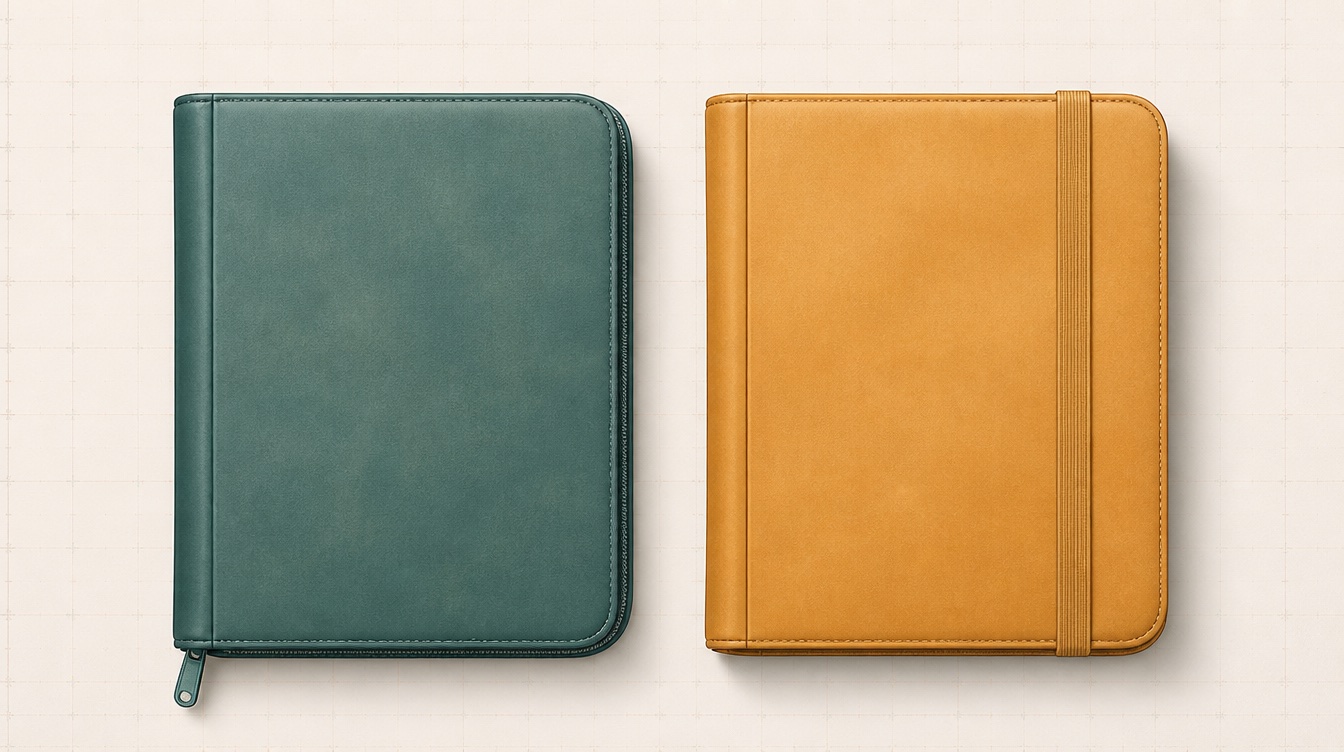
Get the zip if the binder travels. A backpack to a tournament, a shelf that collects dust, a bag that gets tossed around between the car and a game store. The zip compresses the whole page block shut, so pages don't splay open and loose grit can't work its way between pockets over months of that treatment.
Get the strap if the binder stays put. It lives on a shelf or comes out at your own table, and you'd rather flip through it in one motion than work a zipper every time you want to show someone a page. The strap only clamps the fore-edge, which is faster but leaves the rest of the edge open.
Dust and drop protection
A zip binder seals the entire page stack, not just one edge, which matters more than it sounds like over a year of handling. Dust, crumbs, and whatever else lives at the bottom of a backpack can't reach the pockets once the zip is closed, and a dropped zip binder doesn't fling pages open on impact the way an unsealed edge can. That protection compounds over time too. A strap binder that rides in a bag twice a week for a season picks up more grit at the open edge than one that never leaves a shelf, even if neither binder is ever actually dropped. That's the case for the zip in one sentence: it's a closure built for a binder that leaves the house.
Speed and weight
The strap gives up dust sealing for a page block that's faster to open, faster to close, and lighter in the hand since there's no zipper track running the length of the binder. At a trade table, that speed matters more than it seems like it should. Fumbling a zipper while someone's waiting to see your binder is a real annoyance, and it's the whole reason strap and open ring binders still exist next to zip ones. Weight adds up over a full binder too. A zipper track and its reinforced edge add real material along one whole side of the page block, and on a fully loaded 12-pocket binder that difference is noticeable in a bag by the end of a long con day.
The natural experiment: same binder, different closure
Vault X sells its 9-Pocket Exo-Tec binder in both a zip and a strap version, same side-loading pockets, same 360-card capacity, same confirmed fit for double sleeved cards. That's about as close to a controlled comparison as our data gets: hold pocket count and capacity constant, change only the closure, and see what's actually different.
| Vault X binder | Pockets | Capacity | Closure | Double sleeved fit? |
|---|---|---|---|---|
| Vault X 9-Pocket Exo-Tec Zip Binder | 9 | 360 cards | Zip | Yes |
| Vault X 9-Pocket Exo-Tec Strap Binder | 9 | 360 cards | Strap | Yes |
Nothing about the zip mechanism adds or removes storage, and nothing about the strap does either. Both versions hold the same cards the same way once you're past the closure. The same pattern holds at other sizes too. The 4-Pocket Exo-Tec Zip Binder and 4-Pocket Strap Binder both land at 160 cards, and the 12-Pocket Zip and 12-Pocket Strap both land at 480. Across every matched pair in our data, capacity tracks pocket count, not closure. If you've been holding off on a decision because you assumed one closure holds more cards, that assumption isn't the reason to pick either one.
The pattern holds beyond Vault X
Vault X isn't the only brand that sells the same page in both closures. Ultimate Guard runs the same split: the Zipfolio 360 18-Pocket XenoSkin (zip, 360 cards) sits next to the Flexxfolio 360 18-Pocket (no zip, 360 cards), and the QuadRow Zipfolio 480 12-Pocket pairs with the QuadRow Flexxfolio 480 12-Pocket the same way, zip against no zip at an identical 480-card capacity. Neither Ultimate Guard pair changes capacity across the closure any more than Vault X's does. Two brands, four matched pairs, zero cases where the zip or its absence moved the card count. That's enough repetition in our data to treat "closure doesn't touch capacity" as settled, not a one-brand coincidence.
When the strap wins outright
There's one case where the strap isn't just a lighter trade, it's the better tool: a binder you're actively working from, open on a table while you sort or trade for an hour at a time. Opening and closing a zip repeatedly during a session adds friction that a single buckle doesn't, and that friction is the whole argument against the zip in this one context. If that's how you use a binder most of the time and it never leaves a controlled space, the dust and drop protection the zip offers doesn't get exercised often enough to matter. Buying the zip anyway isn't wrong, it just carries protection you'll rarely exercise, which some collectors are happy to have on hand regardless.
Quick answers
What are the benefits of a zippered binder specifically? It seals the full page stack instead of just one edge, which keeps dust and debris out and stops pages from splaying open in a bag. It also holds up better to being dropped or tossed around, since nothing flings open on impact the way an unsealed fore-edge can.
Does either closure change how many cards fit? No. Vault X's matched zip and strap pairs land at identical capacities, 160, 360, and 480 cards depending on pocket count, so the closure is a separate decision from how much the binder holds.
If you're still not sure, default to the zip. It does everything the strap does and adds protection you won't notice you needed until the day you do.