D-ring vs O-ring binders
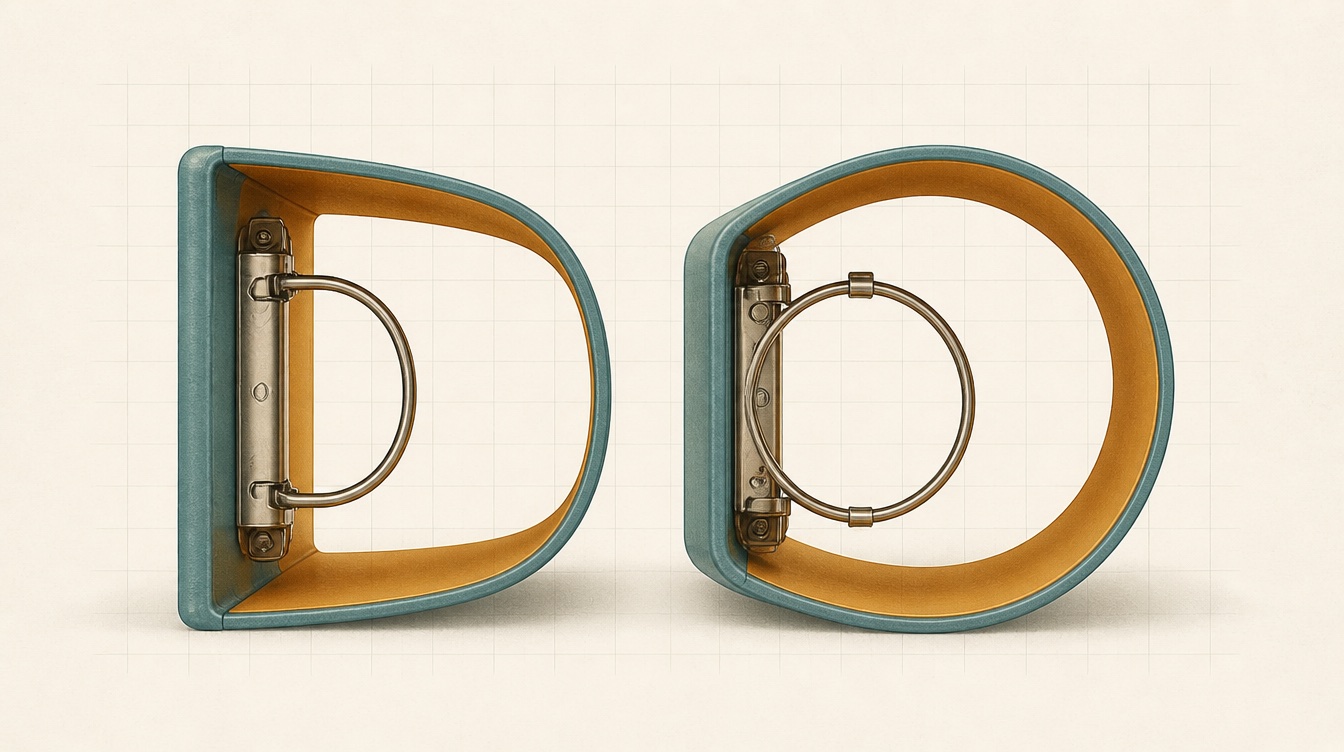
D-rings are the better choice for a card binder. The flat back edge of a D-ring sits against the spine, which keeps pages stacked directly on top of each other instead of curving around a fully round ring. O-rings are round all the way around, so a page has to bow slightly to wrap that curve every time you turn one, and repeated bowing is what eventually presses a card's edge against the ring or lets it shift and rub against the page next to it. Ring binders built for cards, like the Vault X Slim and Large Exo-Tec Ring Binders, hold their standard-size pages against a fixed set of rings, so ring shape is worth checking before you buy, not just the page count.
Why ring shape changes how pages lie
Picture a binder standing on a shelf, spine to your left. A D-ring has a flat edge facing the spine and a curved front, shaped like a capital D lying on its side. Pages hang from that flat edge and stack straight down, sheet on sheet, in a neat column. An O-ring is round all the way around, so a page loops over a curve on both the front and back edge. That loop needs a little extra material to wrap the curve, which is why O-ring pages tend to drift forward as you flip through a full binder instead of staying stacked in a tight column.
For a card binder specifically, that drift matters more than it does in an office binder full of loose paper. A 9-pocket page holding cards is stiffer and heavier per sheet than printer paper, so a page already prone to shifting on an O-ring shifts further under that added weight. Cards near the ring edge take the brunt of it. Repeated rubbing against a hard pocket seam, or a page corner slowly bending out of true, is the kind of slow wear that shows up as a dent or a soft crease years later, not damage from any single afternoon of flipping pages.
What this means for capacity, too
D-rings also tend to hold more pages for a given ring diameter, since a flat back edge stacks pages more efficiently than a curve does. That's part of why ring-page binders built for cards, rather than a repurposed office binder from a junk drawer, are worth seeking out on purpose. The Vault X Slim Exo-Tec Ring Binder rates for 540 cards and the Vault X Large Exo-Tec Ring Binder rates for 900, both using side-loading pockets and both confirmed to fit double sleeved cards. Neither is a fixed page-count book like a zip binder. You load in pocket pages yourself up to the rated maximum, so ring shape does real, ongoing work every time you add another page rather than sitting there as a one-time spec.
| Ring binder | Capacity | Loading | Double sleeved fit? |
|---|---|---|---|
| Vault X Slim Exo-Tec Ring Binder | 540 cards | Side | Yes |
| Vault X Large Exo-Tec Ring Binder | 900 cards | Side | Yes |
Checking before you buy
Ring shape isn't always printed clearly on a listing, especially outside the card hobby where "3-ring binder" gets used loosely for either style. If a listing doesn't specify, look at product photos for the ring's profile from the side; a D-ring shows a visible flat edge, an O-ring is a clean circle. Or check the description for the word "D-ring" explicitly, since that's the term manufacturers use when they've built the better-holding version on purpose.
Quick answers
Do O-ring binders damage cards right away? No. It's a slow wear pattern from repeated flipping and page drift over months or years, not a risk from any single use.
Are D-ring binders more expensive? Sometimes slightly, since the hinge mechanism costs a bit more to produce, but the gap is usually small next to the price of the cards you're protecting.
Does ring shape affect how many pockets a page can have? No. Pocket count is a page design choice on its own. Ring shape only affects how the page hangs and stacks, not what's printed or welded onto it.
Can I swap O-ring pages into a D-ring binder? Usually, since both use the same standard 3-ring spacing. What changes is how flat the pages sit once they're loaded in, not whether they physically fit on the rings.
If you're buying a ring binder specifically to hold cards rather than repurposing an old binder from a closet, ring shape is worth the extra ten seconds of checking. It's a small spec that quietly decides how flat your pages sit for the next decade.