Plastic bins vs cardboard boxes for cards
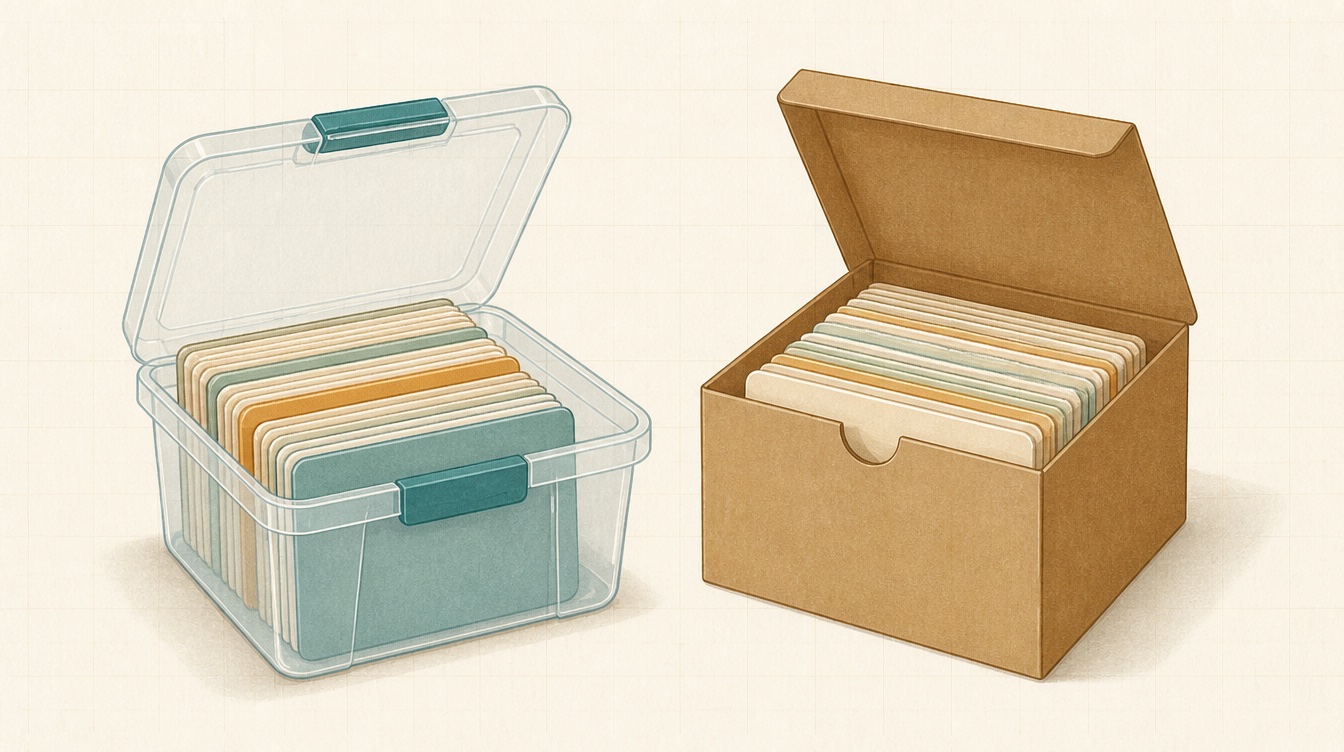
Cardboard boxes are the cheaper, lighter option and they're perfectly fine for cards kept in a stable, climate-controlled room. Plastic bins cost more upfront but win on durability: they don't absorb moisture, they hold their shape under stacking weight, and they survive a spill or a move without turning into pulp. Neither one fixes a bad storage room on its own. The choice is really about how controlled your space is and how long the cards are staying put.
Durability: what actually fails over time
Cardboard is paper, and paper degrades under repeated stress. Stack a few full 800-count boxes on top of each other for a year and the bottom box's corners start to give, especially if the boxes get moved, opened, and closed often. Tape loses its grip, lids soften at the fold, and a box that started out crisp ends up crushed at one edge. A plastic bin doesn't have that problem. The walls stay rigid under stacked weight, the lid seals the same way on day one and day one thousand, and dropping one doesn't risk crushing a corner.
| Factor | Cardboard box | Plastic bin |
|---|---|---|
| Upfront cost | Lower | Higher |
| Moisture resistance | Poor, paper absorbs it | Good, sheds spills and humidity swings |
| Crush resistance under stacking | Weak over time | Strong, holds shape |
| Weight when loaded | Lighter | Heavier |
| Best fit | Short to medium term, stable room | Long term, moves, less controlled spaces |
Moisture: the bigger risk cardboard actually carries
Paper is hygroscopic, meaning it absorbs and releases moisture depending on what's around it, which is exactly why a stable 45-55% humidity band matters so much for cards. A cardboard box does nothing to buffer that; it's made of the same material that's swelling and shrinking. A plastic bin acts as a real barrier. It won't fix a basement that's already damp, but it stops a direct spill, a leaky pipe, or a humid week from soaking straight through to the cards. If your storage room already sits in the right range, this matters less. If it doesn't, or you're not sure, a bin buys real insurance a cardboard box can't.
Cost: where the tiers actually land
Cardboard bulk boxes sit at the cheapest tier available, which is exactly why they're the default for storing commons and duplicates you're not precious about. A basic plastic storage tote is the next step up, a modest jump for a lot more durability. Purpose-built stackable card storage bins sit at the top of the range, designed specifically around card dimensions instead of being a general-purpose tote pressed into service. None of these tiers are expensive in absolute terms compared to the cards most people are storing in them, so the decision usually comes down to how much you value not thinking about it again.
When cardboard is still the right call
If your cards live in a closet or a spare room that already stays dry and temperature-stable, a cardboard box is not a compromise. It's cheap, it stacks fine for casual use, and it does the job. Cardboard also breathes slightly better than sealed plastic, which matters if you're worried about trapping any existing moisture inside a sealed container. The honest case against cardboard isn't that it fails in a good room; it's that it fails the moment the room isn't good, and a lot of storage rooms are less controlled than people assume.
When a plastic bin is worth the extra cost
Anything going into a garage, a basement, or a storage unit, even temporarily, is safer in plastic. The same goes for a collection you're moving house with, since cardboard boxes are exactly the thing that gets crushed under other boxes in a moving truck. If you've got a collection you actually care about and you're not fully confident in your storage room's humidity, spend the extra money once and stop worrying about it.
Quick answers
Do plastic bins fix a humid basement? No. A bin resists a spill or a short humidity spike, but it won't undo a room that sits outside the 45-55% band long term. Move the cards to a better room if you can.
Are cardboard boxes bad for long-term storage? Not automatically. In a stable, climate-controlled room, cardboard holds up fine for years. The risk shows up in unstable rooms or with heavy stacking, not from the cardboard itself aging.
Is it worth mixing both? Often, yes. Plenty of collectors keep everyday bulk in cardboard on a shelf and reserve a plastic bin for anything going into storage, moving, or a less controlled space.
Does a sealed plastic bin trap humidity inside? It can trap whatever humidity was already present when you sealed it, so make sure cards go in dry and consider a few silica gel packets if the bin will sit closed for a long stretch.
Buy for the room you actually have, not the room you wish you had. A dry, stable closet doesn't need plastic. Anywhere less certain than that, spend the extra few dollars and stop thinking about it.