The right humidity and temperature for card storage
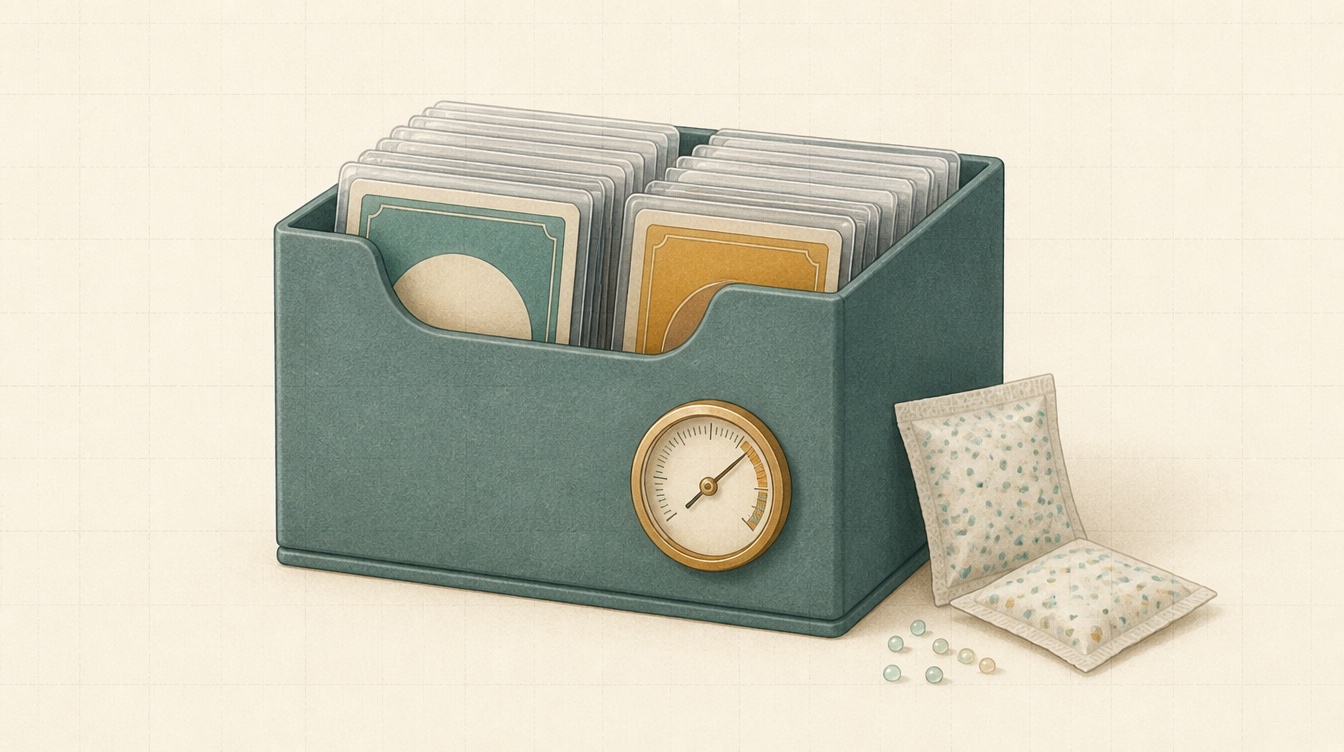
Keep trading cards between 45% and 55% relative humidity and a stable room temperature, roughly 65 to 72F. Skip the garage, the attic, and the basement, all of which swing too far in both directions over a year. If you want extra insurance, a few silica gel packets in a storage box cost almost nothing and absorb the humidity spikes those numbers are meant to avoid.
Worth saying upfront: these are the numbers the collecting community has converged on over decades of storing cardboard, not a controlled lab result. Nobody has run a peer-reviewed study on optimal card humidity. What we do have is a consistent pattern of paper conservators, comic and card collectors, and grading companies all landing in the same rough band, which is about as much confidence as you get outside a lab.
Why humidity matters more than a few degrees of temperature
Cards are mostly paper stock with a plastic coating, and paper is hygroscopic: it absorbs and releases moisture depending on what's around it. Too much humidity and the paper swells, which is how foils and thicker cardstock start to curl or warp. Too little, and the paper turns brittle over the long run, more prone to cracking at a hard crease. Temperature matters too, but it is the swings, not the absolute number, that cause the real damage. A card that sits at a boring, unchanging 68F for a decade is safer than one that bounces between 55F and 90F depending on the season, even if the average works out the same.
| Condition | Target | What goes wrong outside it |
|---|---|---|
| Relative humidity | 45-55% | Above: warping, foil curl, mold risk. Below: brittleness over years |
| Temperature | 65-72F, stable | Swings stress the plastic sleeve and the card stock differently, causing subtle warping |
| Location | Interior room, climate controlled | Garages and attics swing 20-40F+ across a year |
| Extra buffer | Silica gel packets | Absorbs short-term humidity spikes inside a sealed box |
Why garages, attics, and basements are all wrong for different reasons
An attic bakes in summer and can hit temperatures no card should sit in for months. A garage tracks the outdoor swing almost exactly, hot in July, cold in January, with none of a house's insulation smoothing it out. A basement is usually the most stable on temperature, but it is often the most humid room in the house, especially if it's below grade or near a foundation with any moisture intrusion. None of these are dealbreakers for an afternoon, but for long-term storage, an interior closet or a spare room beats all three.
Where silica gel actually helps
Silica gel packets are cheap insurance against a spike, not a fix for a bad storage environment. Drop a few into a sealed bulk box or bin and they'll pull excess moisture out of the air trapped inside, which matters most if the box gets shut tight and left somewhere the ambient humidity isn't perfectly controlled. They do need recharging occasionally (a low oven or a sunny windowsill will dry most reusable packets back out), and they're not a substitute for keeping the room itself in range. Think of them as a buffer for the small, sealed space around your cards rather than a solution for a whole room.
Do I need a hygrometer to actually check this?
Not a bad idea if you're storing anything valuable long term. A basic digital hygrometer costs little and takes the guesswork out of whether your storage room is actually in the 45-55% band or just feels fine. Most people never check and are probably fine, since most homes with central heating and air already land somewhere in that range. But if you're storing six figures of cardboard in a closet you've never measured, a $15 hygrometer is a cheap way to stop guessing.
Quick answers
Is air conditioning enough to keep cards safe? For most homes, yes. Central heating and air already keeps most interior rooms close to the target band without any extra equipment.
Can a dehumidifier fix a bad storage room? It can help a damp basement, but it is one more thing to maintain and monitor. Moving the cards to a drier room in the house is usually simpler.
Does display lighting affect this? Light exposure is a separate issue from humidity and temperature, mostly about UV fading rather than warping, but the same logic applies: avoid direct sun and harsh bulbs on anything you care about long term.
What about short trips, like taking a binder to a card shop? A few hours outside the ideal range won't hurt anything. This is about where cards live for years, not where they spend an afternoon.
None of this requires a dedicated storage room or specialty equipment for most collections. Keep cards somewhere you'd be comfortable living yourself, out of the extremes, and you've already covered the bulk of what humidity and temperature can do to cardboard over time.