How to store trading cards (the whole system)
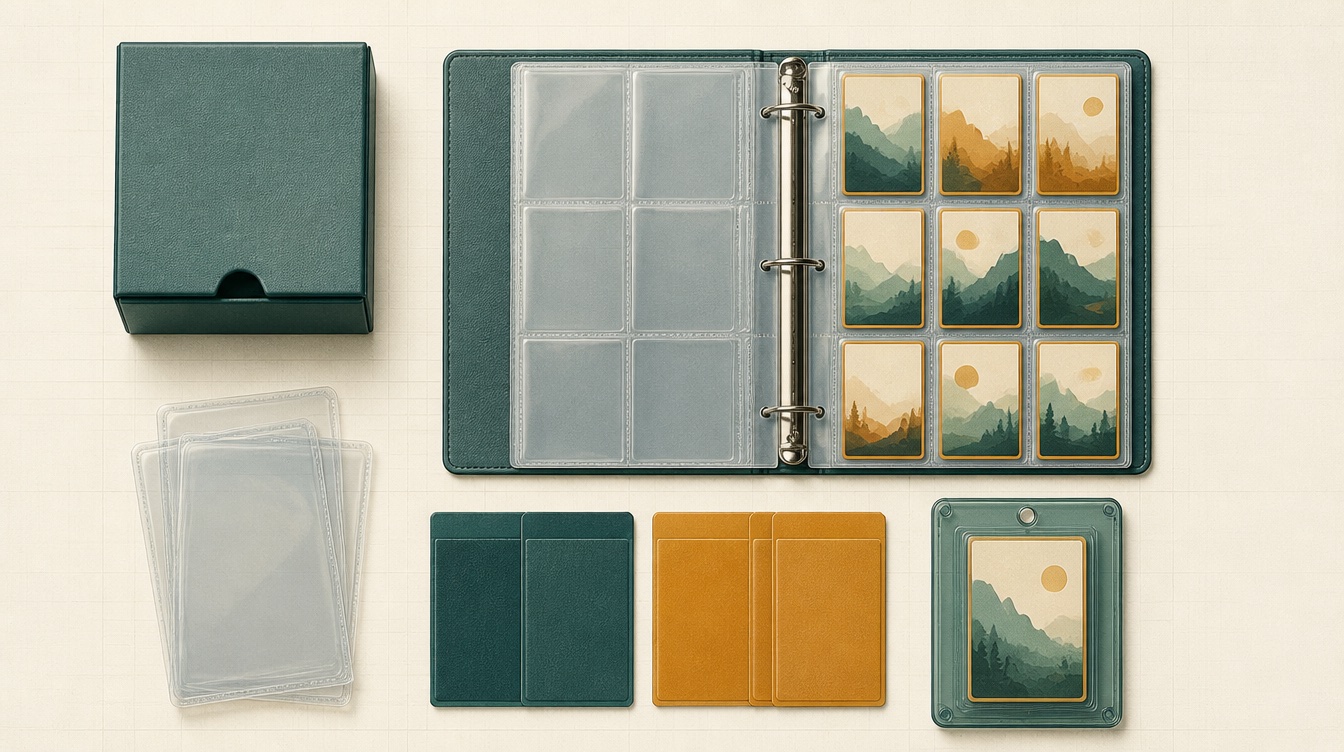
Trading cards do not all deserve the same treatment. A bulk common and a first-edition holo are both "cards," but protecting them the same way either wastes money or leaves something valuable exposed. The system that actually holds up: sort your collection into four value tiers, then match the gear to the tier. Bulk stays loose in boxes. Playables get a single sleeve. Valuables get double sleeved or a toploader. Crown jewels get a one-touch holder or a grading slab. Nothing fancier than that, and nothing less.
Why a tier system beats "just sleeve everything"
Sleeving every card you own sounds responsible, but it is not free. Sleeves cost money, take up space, and add bulk to binders and boxes that were sized for bare cards. Spend that budget on a card worth a quarter and you have wasted plastic. Skip it on a card worth fifty dollars and you are one bent corner away from a real loss. The tier system exists so your protection spending tracks the actual risk.
It also matches how collections really grow. Most people start with a shoebox of commons, pick up a few playable decks, land on a handful of cards worth protecting properly, and eventually own one or two pieces they would hate to damage. The gear below follows that same arc.
| Tier | What lives here | How it's stored |
|---|---|---|
| Bulk | Commons, uncommons, duplicates, cards worth pennies | Loose in a cardboard or plastic bulk box |
| Playables | Cards in a deck you actually shuffle and play | Single standard sleeve |
| Valuables | Cards worth roughly $5 to a few hundred dollars | Double sleeved, or single sleeve plus a toploader |
| Crown jewels | Cards you would not want to lose, high-value singles | One-touch magnetic holder or a graded slab |
Bulk: the cards that don't need individual protection
If a card is worth next to nothing and you are not shuffling it, it does not need a sleeve. Store bulk loose in a sturdy box, sorted however makes it findable later (by set, by color, alphabetically, whatever you'll actually maintain). The box itself is doing the protective work here: keeping cards flat, out of light, and away from moisture. Once a card actually earns a spot in a deck or a binder page, it graduates out of bulk.
Playables: the deck you shuffle
A card that lives in an active deck needs a sleeve regardless of its dollar value, because shuffling is what actually wears cards down: edge whitening, surface scuffing, the slow rounding of corners. A standard sleeve solves this cheaply. If you want the deck itself to close up properly in a deck box, that is a sizing question, and how to double sleeve cards and penny sleeves vs. Perfect Fit both walk through which sleeve combo to use and how.
Valuables: where double sleeving earns its keep
Once a card is worth enough that you would be annoyed to see it dinged, single-sleeve protection stops being enough. The standard move is double sleeving: a snug inner sleeve against the card, then a standard sleeve over that, so the card itself never touches the friction surface. It is also common to single-sleeve and drop the card into a toploader for anything you are not actively playing. We cover the actual cost-benefit of double sleeving in is double sleeving worth it, and if you are trying to fit a double-sleeved deck into a box that will actually close, start with deck boxes that fit 100 double-sleeved cards.
Crown jewels: one-touches and slabs
For the handful of cards that matter most, a one-touch magnetic holder is the collector standard: rigid, snug, and built for a card that is going on a shelf rather than into a deck. If the card is valuable enough to consider grading, a company like PSA or BGS will encapsulate it permanently, at which point your job shifts from protecting the card to protecting the slab. Either way, these cards should not be sharing a box with bulk commons. Use the fit checker to confirm a toploader or one-touch actually matches your card's thickness before you buy.
Building the system without overspending
You do not need to buy every tier at once. Start with sleeves for whatever you actually play, add toploaders as specific cards prove themselves worth more than pocket change, and reserve one-touches for the short list of cards you would actually mind losing. Browse sleeves, deck boxes, binders, and toploaders to see what's out there once you know which tier you're shopping for.
Quick answers
Do I need to sleeve every card I own? No. Bulk cards worth a few cents don't need individual sleeves; a box is enough. Save sleeves for cards you play or cards worth protecting individually.
What's the cheapest way to protect a large collection? Sort by value first. Most of a big collection is bulk and belongs in a box, not a sleeve. That single sorting pass saves more money than any specific product choice.
Should a graded card still be sleeved? No, and you shouldn't try. The slab itself is the protection; adding a sleeve over it does nothing and can trap moisture against the case.
Do binders replace sleeves? Not on their own. A binder page holds a card in place, but if the card is worth protecting from surface wear, sleeve it before it goes in the pocket.
The tiers will shift as your collection does. A card that was a throwaway pull last year might be worth protecting today, and that is fine. Reassess every so often rather than trying to get it perfect on day one.