Always sleeve before the toploader
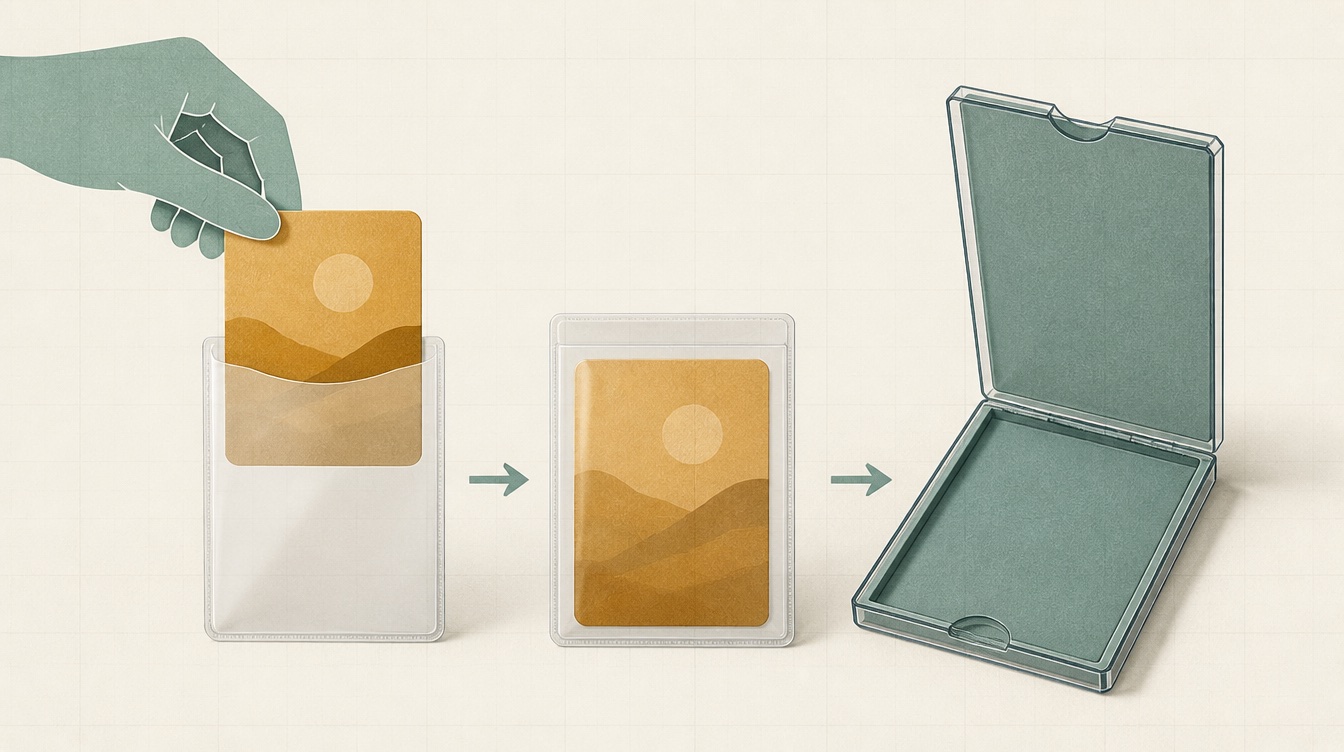
Yes, always sleeve a card before it goes into a toploader. A penny sleeve is the standard pairing, not a colored deck sleeve, because it's cheap, clear, and does one job well: keeping the card from sliding against the rigid plastic interior every time the toploader shifts. A bare card dropped straight into a toploader has real room to slide around in there, and that motion is what causes the fine scuffing collectors are trying to avoid in the first place.
The room a bare card has to move
A standard toploader, the 35pt size used for Ultra Pro's Regular Toploader, BCW's Standard holder, and Cardboard Gold's PRO 3x4, measures 69.9x98.4mm on the inside. A standard card measures 63x88mm. Set those two numbers side by side and there's 6.9mm of extra width and 10.4mm of extra height with nothing filling it. That's not a snug fit, that's a card with room to slide corner to corner every time the toploader gets tilted, stacked, or shipped.
A penny sleeve closes most of that gap. The Ultra Pro Penny Sleeve and BCW's standard card sleeves both measure 66.7x92.1mm, which cuts the slack down to about 3.2mm of width and 6.3mm of height inside that same 35pt toploader. The card still slides in and out easily, but it isn't rattling loose against rigid plastic on every side.
| Item | Size (WxH mm) | Clearance inside 35pt toploader (69.9x98.4mm) |
|---|---|---|
| Bare card | 63x88mm | +6.9mm / +10.4mm |
| Card + penny sleeve | 66.7x92.1mm | +3.2mm / +6.3mm |
| Toploader interior | 69.9x98.4mm | n/a |
That difference is the entire argument. A penny sleeve doesn't make the fit perfect, nothing does inside a rigid holder sized for a range of cards, but it meaningfully tightens the gap the card is otherwise free to slide around in.
Why a penny sleeve specifically, not a deck sleeve
Deck sleeves, the matte or glossy kind sized for shuffling a 60 or 100-card deck, are built for a different job: surviving hundreds of shuffles and bridges without splitting at the seam. They're not designed with toploader storage in mind, and a lot of them are tinted or textured in ways that get in the way of seeing the card clearly through the rigid plastic. A penny sleeve is thin, clear, and single-purpose. It exists to sit under something else, whether that's a toploader, a binder page, or a bulk box, and its 66.7x92.1mm size was set for exactly that kind of pairing.
What the sleeve is actually protecting against
The card surface itself is the thing at risk, not the corners or edges, which the rigid toploader shell already guards well. Every time an unsleeved card shifts inside a toploader, its surface makes contact with the interior plastic, and repeated contact over months of handling is where fine scuffs and surface wear start to show up, especially on foils. A thin penny sleeve is a soft buffer between card and shell that costs a fraction of a cent per use. Skipping it to save that fraction is the kind of shortcut that shows up later as a graded card losing points on surface.
When to add more than a penny sleeve
Some collectors add a second, thicker sleeve or go straight to a semi-rigid holder for cards headed to grading, since submission companies generally want a card protected but not double-boxed. If you're prepping something for grading, our what does 35pt mean guide explains toploader thickness ratings, and our guide to whether sleeved cards fit in toploaders covers what happens once you start adding thicker sleeve stacks on top of the base penny sleeve.
Quick answers
Do you sleeve a card before a toploader? Yes, a penny sleeve every time. It's cheap, it's clear, and the millimeter gap between a bare card and a standard toploader is large enough that skipping the sleeve leaves the card free to slide and scuff against the interior.
Is a penny sleeve enough, or do I need a thicker sleeve too? A penny sleeve is enough for everyday storage and shipping. Thicker sleeves or semi-rigid holders come into play mostly for grading prep or extra-valuable cards headed somewhere with rough handling.
Does the sleeve make the card too tight for the toploader? No. Even with a penny sleeve added, the card still has a few millimeters of clearance on every side inside a standard 35pt toploader, enough to slide in and out without forcing it.
Can I use a colored deck sleeve instead of a penny sleeve? You can, but it's not the common choice. Deck sleeves are built for shuffling, not for sitting under a rigid holder, and a clear penny sleeve lets the card stay visible, which matters if the toploader is for display or grading submission.
A penny sleeve costs almost nothing and closes most of the gap a bare card would otherwise have to slide around in. If you've been dropping raw cards straight into toploaders to save a step, that's the one habit worth breaking before your next grading submission or long-term storage box. Check our toploader directory if you're shopping sizes to match a specific sleeve stack.