How to clean a trading card (carefully)
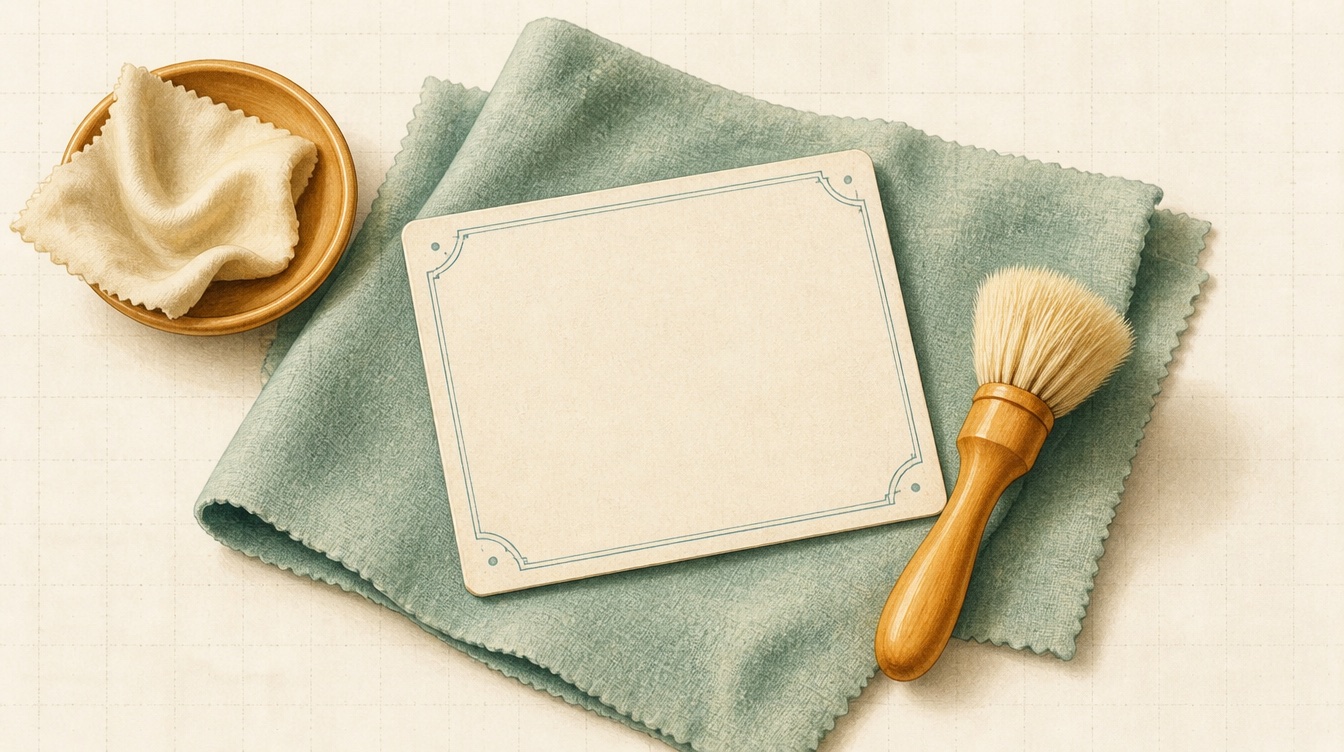
For almost every card, cleaning means one thing: a dry microfiber cloth, wiped gently from the center out toward the edges. That lifts dust, light fingerprint oil, and the general haze that builds up from handling. Anything past that (water, alcohol, glass cleaner, a pencil eraser, the hem of your shirt) isn't cleaning a card. It's testing how much damage the card can absorb before something on it changes for good.
What a dry wipe actually fixes
A card's surface is a printed layer sealed under a thin gloss or UV coating. Dust and fingerprint oil sit on top of that coating, which is exactly why a dry cloth works: you're lifting residue off a sealed surface, not touching the print underneath. A few passes with a clean microfiber cloth clears haze and smudges without putting anything on the card that has to dry or evaporate afterward.
What it won't fix: edge whitening, surface scratches, print lines, or anything that happened to the card itself rather than to the dust sitting on it. If the coating is already scuffed, wiping it won't un-scuff it. That's a different problem, and no amount of cleaning solves it.
When people reach for something stronger, and why not to
Saliva shows up constantly as a "trick" for stuck-on grime. It's a bad one. Saliva carries moisture and enzymes that sit on the coating and can leave faint residue behind, especially on darker borders where any change in sheen shows. Alcohol and glass cleaner are worse: both are solvents built to cut through oil and wax, and a card's gloss coating is exactly the kind of thin finish they're designed to dissolve. A single wipe can leave a permanent dull patch, and there's no undoing it once the coating is gone. Foils are the most fragile version of this problem, since the foil layer sits even closer to the surface than standard gloss.
A magic eraser is an abrasive, full stop. It works on kitchen counters because it's mildly sanding the surface down. Do that to a card and you're sanding off the print. And soaking a card in water doesn't clean it, it starts pulling apart the layers that make up the cardstock itself, which is its own kind of damage we cover in salvaging water-damaged cards.
| Method | What it does | Verdict |
|---|---|---|
| Dry microfiber wipe | Removes dust and light fingerprint oil | Safe, the only method we'd actually suggest |
| Canned air or a soft brush | Clears loose debris from corners and edges | Safe |
| Barely damp microfiber, used sparingly | Can lift a stubborn smudge | Only if you must, and dry the card immediately |
| Isopropyl alcohol or glass cleaner | Dissolves the gloss coating | Don't |
| Saliva | Adds moisture and residue to the surface | Don't |
| Magic eraser or any abrasive | Sands off the print layer | Don't |
| Water soak | Breaks down the card's internal layers | Don't |
What grading companies think about it
PSA, BGS, and CGC all treat cleaning as a form of alteration once it changes the card's surface, and graders are looking at sheen and color consistency all day. A dulled patch where alcohol touched the gloss, or an odd texture where a card got scrubbed, reads exactly like what it is. At best you get a details-only grade or a lower number than the card would've earned untouched. At worst the card comes back flagged. If you're planning to submit a card, do the dry wipe and stop there. Let the graders judge the card as it actually is.
The cards that need this least
Cards that went into a sleeve on day one rarely need cleaning at all, because they never had the chance to collect dust and hand oil in the first place. If you're pulling cards out of a binder or box and finding them grimy, that's usually a sign they sat loose longer than they should have. Sleeving early is cheap insurance against ever having this conversation, and it's worth reading what actually damages stored cards if grime keeps showing up on cards you thought were protected.
Quick answers
Can I clean a card before selling it? A dry wipe is fine and expected. Anything more, and a buyer or grader can usually tell.
Does cleaning increase a card's value? No. It removes surface grime, nothing else. It won't touch whitening, scratches, or centering, and it can't push a card from near mint back to mint.
Is it safe to clean foil or holo cards? Be even more careful. The foil layer is thinner and more prone to showing damage than standard gloss, so stick to dry cloth only.
What about older cards from decades ago? Vintage cardstock is more fragile across the board. A dry wipe is still fine; anything with moisture is riskier than it would be on a modern card.
The best cleaning is the one you never have to do, because the card went into a sleeve before it ever picked up the dust in the first place.