Binder, toploader, or box? Where each card goes
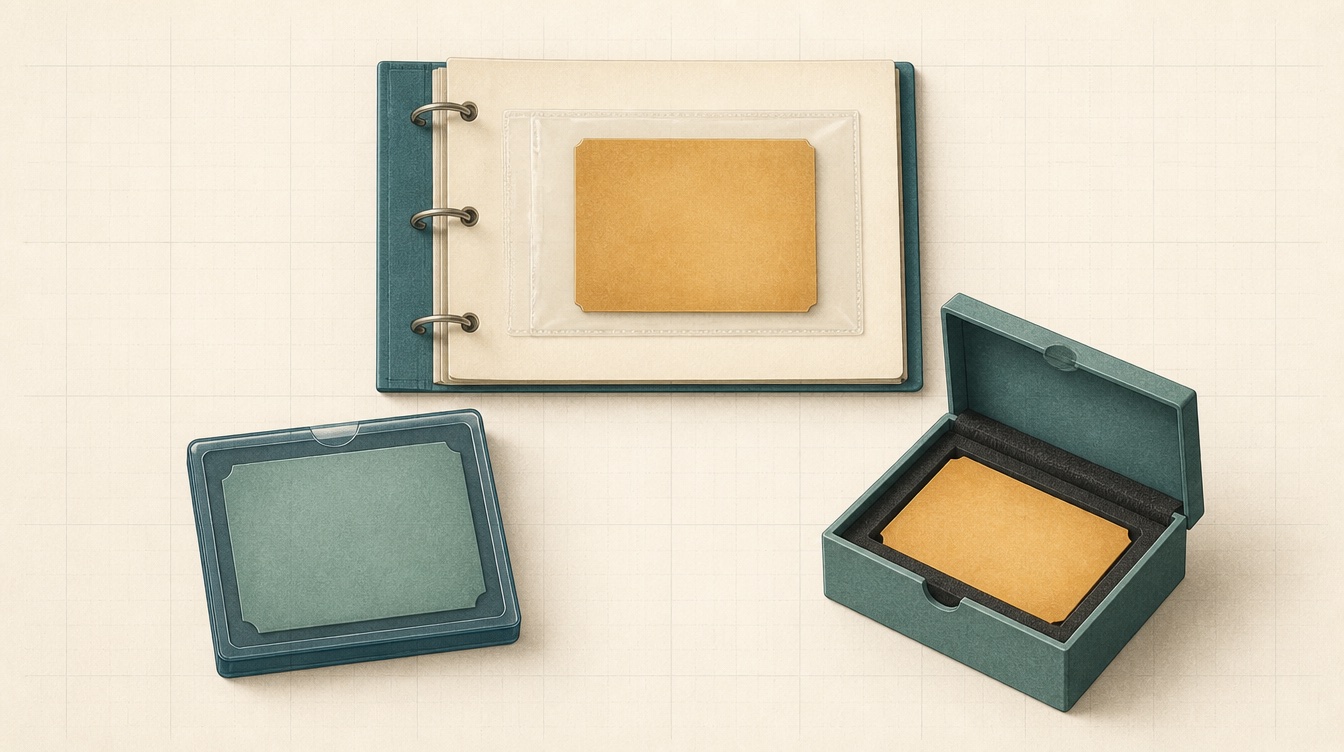
Send a card to whichever container matches how you actually use it. A played, sleeved deck belongs in a deck box, sized to how many cards you're sleeving and whether they're single or double sleeved. A single card you want protected on its own, especially one you might sell, ship, or submit for grading, belongs in a toploader. Everything you want to browse, compare, or flip through as a whole collection belongs in a binder. Value shifts the recommendation only at the extremes, when a card is worth enough that you'd rather it ride alone in rigid plastic than share a flexible binder pocket with eight neighbors.
Bulk and mid-value cards: the binder
A binder pocket is a flexible pouch, not a rigid shell, and every one of the 39 binders in our data opens on the side edge so pages can be flipped without cards sliding out. That makes a binder the right home for a card you want to see and compare against others, a played set, a growing collection, a full playset of commons. It's a worse home for anything you'd be upset to see get a corner ding, since a binder pocket protects against falling out, not against pressure or a rough shuffle through a stack.
| Container | Best for | Representative capacity | Protection style |
|---|---|---|---|
| Binder (Vault X 9-Pocket Exo-Tec Zip) | Browsing and organizing a collection | 360 cards | Flexible pocket, side-loading |
| Deck box (Ultimate Guard Boulder 100+) | A played, sleeved deck | 100 double sleeved cards | Rigid box, fixed interior depth |
| Toploader (BCW 3x4 Toploader, 35pt) | One raw card, alone | 69.9x98.4mm interior | Rigid shell, no flex |
| Toploader-fit binder (BCW Z-Folio 9-Pocket LX Album - Toploaders) | Many toploadered cards, organized | 252 cards | Rigid pocket sized for a shell |
Played decks: the deck box
A deck box exists for cards that get shuffled, drawn, and handled during play, and it's built around a fixed interior depth rather than a flexible pocket. That's a strength until your stack gets thicker than the box allows, at which point the lid simply stops closing rather than stretching to accommodate it the way a binder pocket would. If you're deciding between single-sleeved and double-sleeved storage, check the box's stated capacity for each, since the same box often holds noticeably fewer cards double sleeved than single sleeved.
The single card worth protecting alone: the toploader
Once a card is valuable enough, or fragile enough, that you don't want it touching another card at all, it goes in a toploader by itself. A toploader is a rigid plastic shell, and its interior cavity runs bigger than a sleeve alone, 69.9x98.4mm on the standard 35pt BCW and Ultra Pro versions, with thicker point values available for cards carrying extra sleeve layers. That's the container for a card being shipped to a buyer, submitted for grading, or just kept apart from everyday handling. Check the toploader size chart if you're not sure which point value matches your sleeving setup.
When you want both: toploader-fit binder pages
The gap between "protect this card alone" and "see it alongside the rest of my collection" is where toploader-fit binders live. The BCW Z-Folio 9-Pocket LX Album - Toploaders, the TopDeck TopLoader Binder, and the Gemloader Premium 3x4 Toploader Fit Binder all take a toploadered card directly into a page pocket, trading page count for pocket size so the shell fits without a fight. It's the pick for a shelf of graded-adjacent or high-value pulls you want visible and flippable without pulling each one out of its shell to look at it.
Quick answers
Should every valuable card go in a toploader? No. A toploader is for a card you're protecting individually, not a blanket upgrade for anything expensive. A mid-value card in a good double sleeve, sitting in a confirmed-fit binder pocket, is already well protected and easier to browse.
Can I put a toploadered card straight into a regular binder page? Don't. A standard pocket is cut for a sleeved card, and a toploader is both bigger and rigid where a sleeve flexes. Forcing it in stretches the pocket seam and doesn't give the card a clean fit anyway.
What's the actual difference between a deck box and a binder, protection-wise? A deck box has a hard interior wall that either fits your stack or doesn't. A binder pocket flexes around what you put in it, which is more forgiving on thickness but offers less rigid protection against a hard knock.
Most collections need all three containers at once, not one winner. The mistake is picking a single container for everything, whether that's binder-ing your whole collection including the cards you'd actually rather see alone, or toploadering commons that were never at risk in the first place.