Art sleeves vs clear sleeves
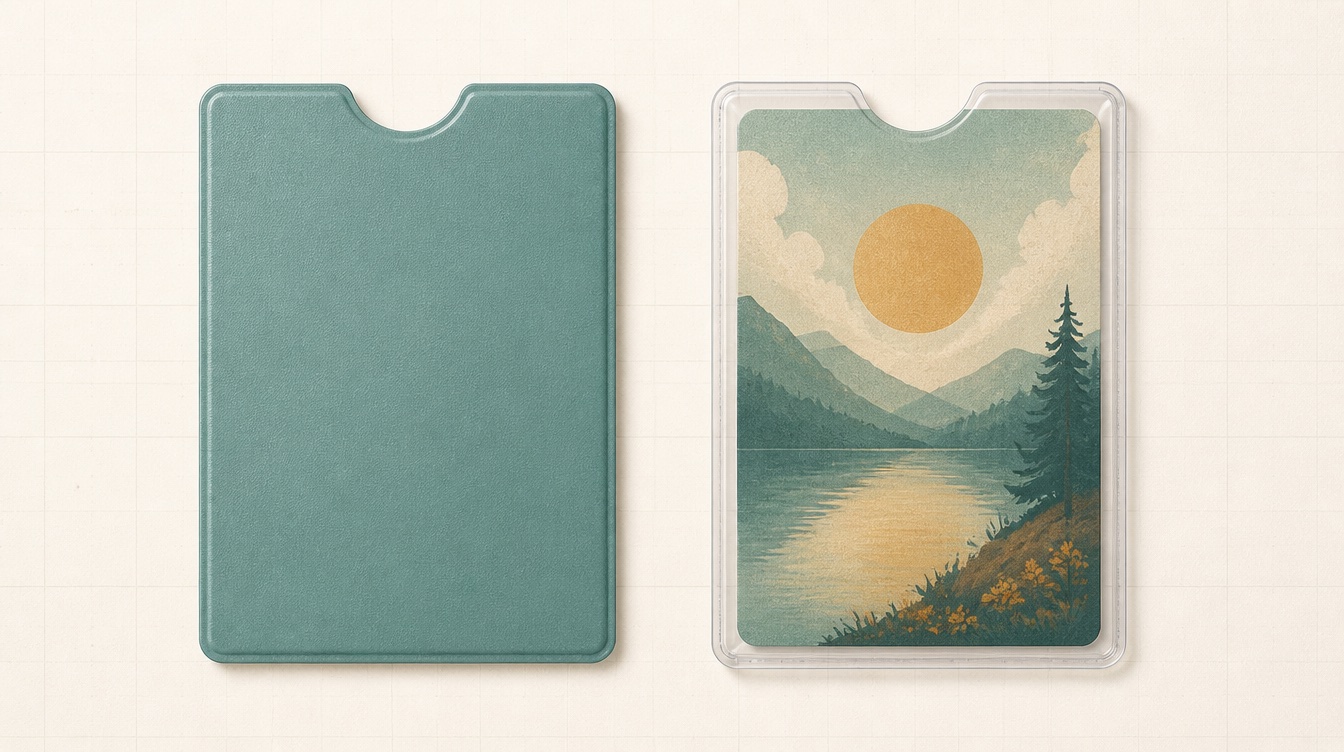
Art sleeves and clear sleeves built on the same brand's standard line share the same shell, so switching to a printed back doesn't change what deck box or binder pocket your cards fit into. What does change is whether that art sleeve is legal at a sanctioned event, since most tournament rule sets require every sleeve back in a deck to look identical, and a printed design gets scrutinized for that the same way a solid color does. Fit is a non-issue. Legality and long-term wear are the real questions.
The shell doesn't change
Dragon Shield already proves this inside its own lineup. Matte, Dual Matte, and Classic Sleeves are three different backings, one clear-ish matte, one dual-toned, one solid color, and all three land at 66x91mm. A printed art sleeve from any major brand's standard line is built on that same shell.
| Sleeve line | Backing style | Size (WxH) |
|---|---|---|
| Dragon Shield Matte Sleeves | matte, single color | 66x91mm |
| Dragon Shield Classic Sleeves | solid color | 66x91mm |
| Dragon Shield Dual Matte Sleeves | two-tone | 66x91mm |
| Ultra Pro Eclipse Matte Deck Protector | matte, single color | 66x91mm |
| Ultimate Guard Katana Sleeves (Standard) | matte, single color | 66x91mm |
| Gamegenic Prime Sleeves | matte, single color | 66x91mm |
If a card fits one sleeve in this table, it fits the printed one built on the same shell. There's no size penalty for wanting art on the back.
The rule that actually matters: back uniformity
Sanctioned tournament rules exist mainly to stop marked cards, and the way they do that is by requiring every sleeve in a deck to be indistinguishable from the back. A solid color clears that bar automatically. A printed art sleeve has to clear it too, which means every sleeve in the deck needs to be the exact same design, the exact same print run, and ideally purchased and opened together so wear patterns don't start diverging card to card. A single scuffed or scratched art sleeve mixed into an otherwise clean set is exactly the kind of thing a judge is trained to flag, even if nobody meant anything by it.
This is where art sleeves quietly fail people who don't plan for it. You buy one pack, sleeve your deck, and six months later you're topping off with a second pack from a different print batch because a few sleeves tore. If the printing shifted even slightly between runs, or if the older sleeves have visibly more wear than the new ones, you've got a deck that doesn't clear the uniformity bar anymore. Clear and solid-color sleeves dodge this problem entirely because wear on a plain surface reads as wear, not as a potential marking.
Wear shows up faster on art
A scuff on a solid color sleeve is a scuff. The same scuff on a printed art sleeve interrupts the image, and that's more visible at a glance, which is exactly the kind of thing that draws a second look at a tournament table. Art sleeves also tend to get handled more carefully by their owners since they cost more and feel more personal, which paradoxically means people are slower to retire a worn one when they should. If you love an art sleeve design, plan to replace the whole set together rather than patching in a spare sleeve here and there.
Which one we'd buy
Browse the full sleeve directory if you're comparing specific lines side by side. For anything going to a sanctioned event, we'd default to a clear or solid-color sleeve every time. It sidesteps the uniformity question entirely and there's nothing to second-guess at a judge's table. For casual play, kitchen-table games, or a deck that lives mostly in a binder, art sleeves are a fair trade of a little extra wear-tracking responsibility for a deck that actually looks like yours. If you go that route, buy enough of the same print run to sleeve the whole deck plus a few spares from day one, so you're never stuck mixing an odd sleeve in later. Whichever style you land on, our Dragon Shield vs KMC vs Ultra Pro guide has the size comparison across the brands most likely to sell both a clear and a printed version of the same sleeve.
Quick answers
Are art sleeves the same size as clear sleeves? Yes, in the standard lines from Dragon Shield, Ultra Pro, Ultimate Guard, and Gamegenic, printed and clear sleeves share the same 66x91mm shell. Backing design doesn't change the footprint.
Can I use art sleeves at a tournament? Often yes, as long as every sleeve in the deck is the identical design with no visible wear differences between them. Check your event's specific sleeve policy, since it's the uniformity rule, not the artwork itself, that trips people up.
Do art sleeves protect cards worse than clear sleeves? No, the plastic underneath the print does the same job. The print is cosmetic, not structural.
Should I put a clear sleeve over an art sleeve? Plenty of players do exactly that to keep the printed design from taking shuffle wear directly. It adds a layer and a little bulk, but it's the standard fix for people who want to keep an art sleeve looking uniform for as long as possible. See our standard card sleeve size guide for the clearance math on stacking an extra layer.
The size chart was never the obstacle here. It's whether every sleeve in the box still looks like the one next to it three months from now.